
Safeguarding Advice
Senior Designated Staff for Safeguarding:
Jacqui Hardie - Headteacher and Designated Safeguarding Lead
Sarah Woodison - Designated Safeguarding Lead
Laurie Beaumont - Deputy Designated Safeguarding Lead
Safeguarding at Weeting
Please click below to view our current Safeguarding Policy.
Safeguarding and Child Protection Statement (September 2025)
Under section 175 of the Education Act 2002 (as amended), *the Education (Independent School Standards) Regulations 2014, the Non-Maintained Special Schools (England) Regulations 2015, and the Apprenticeships, Skills, Children and Learning Act 2009 (as amended) to have arrangements in place to safeguard and promote the welfare of children.
We will endeavour to provide a safe and welcoming environment where children are respected and valued.
The school will therefore be alert to signs of abuse, neglect and exploitation and will follow the Norfolk Safeguarding Children Partnership Board’s procedures to ensure that children receive appropriate and effective support and protection.
Parents/carers should know that the law requires all school staff to pass on information which gives rise to a concern about a child’s welfare, including risk from neglect, physical, emotional or sexual abuse and exploitation. Parents/carers should know that records of safeguarding concerns may be kept about their child. They should be informed that school staff will seek, in general, to discuss any concerns with them including referrals to other agencies.
Local procedures state that “Consent should always be sought from an adult with parental responsibility for the child/young person before passing information about them to Children’s Services, unless seeking consent would place the child at risk of significant harm or may lead to the loss of evidence for example destroying evidence of a crime or influencing a child about a disclosure made.” This includes allowing them to share information without consent, if it is not possible to gain consent, if it cannot be reasonably expected that a professional gains consent, or if to gain consent would place a child at risk.
Where there is a need to share special category personal data, the Data Protection Act 2018 contains ‘safeguarding of children and individuals at risk’ as a processing condition that allows professionals to share information.
In accordance with legislation and local Information sharing protocols, we will ensure that information is shared securely and sensitively. Information will only be shared with other services where it is deemed necessary and proportionate to ensure that children are safe and receive the right service. In all circumstances, the safety of the child will be the paramount concern.
Schools will contact Children’s Services when they have reasonable cause to suspect a child may be suffering or likely to suffer significant harm. Occasionally, concerns are passed on which are later shown to be unfounded. Parents/carers will appreciate that the member of staff in the school with responsibility for child protection (known as the Designated Safeguarding Lead or Deputy Designated Safeguarding Lead) was carrying out their responsibilities in accordance with the law and acting in the best interests of all children.
Holding power
Under Section 3 (5) of the Children Act 1989, any person who has care of a child “may….do what is reasonable in all the circumstances of the case for the purpose of safeguarding promoting the child’s welfare”. This means that on rare occasions, a school may need to “hold” a child in school whilst Children's Services and the Police investigate any concerns further.
Support when the school is closed
If you believe that a child is at immediate risk of harm please ring 999.
If you are concerned about the safety of a child, you are able to contact the Children Advice and Duty Service (CADS) through Norfolk Council Customer Service on 0844 800 8020.
Support at School
You can telephone the school to arrange a call back or meeting on: 01842 810587
You can email the school on: Weeting@trinitypartnership.norfolk.sch.uk
Designated Safeguarding Lead (DSL)
Dr Jacqui Hardie jhardie@trinitypartnership.norfolk.sch.uk
Miss Sarah Woodison swoodison@trinitypartnership.norfolk.sch.uk
Deputy Designated Safeguarding Lead (DDSL)
Miss Laurie Beaumont lbeaumont@trinitypartnership.norfolk.sch.uk
Prevent Lead
Dr Jacqui Hardie jhardie@trinitypartnership.norfolk.sch.uk
Designated Teacher for LAC/CLA
Dr Jacqui Hardie jhardie@trinitypartnership.norfolk.sch.uk
Mental Health Lead
Vacancy
Trust Safeguarding Representative
Mr David Barrett
Useful Links and Resources:
Childline – www.childline.org.uk Tel: 0800111
NSPCC – www.nspcc.org.uk
Norfolk Safeguarding Partnership Board
Norfolk Mental Health Support for Children and Young People
Prevent
As part of Weeting CE Primary School’s ongoing safeguarding and child protection duties we are fully behind the government’s Prevent Strategy.
From 1 July 2015 all schools are subject to a duty under section 26 of the Counter-Terrorism and Security Act 2015, in the exercise of their functions, to have “due regard to the need to prevent people from being drawn into terrorism”. This duty is known as the Prevent Duty for Schools.
At Weeting, we build children's resilience to radicalisation by promoting fundamental British values and enabling our pupils to challenge extremist views.
The statutory guidance refers to the importance of Prevent awareness training to equip staff to identify children at risk of being drawn into terrorism and to challenge extremist ideas. The Home Office has developed a core training product for this purpose . All our staff have received this training. The DSL and DDSL have also completed additional training to support with this.
Please click here for a link to the Prevent Duty for Schools.
Government advice site for parents.
Please click here for a link to the official Prevent Strategy document.
Online safety
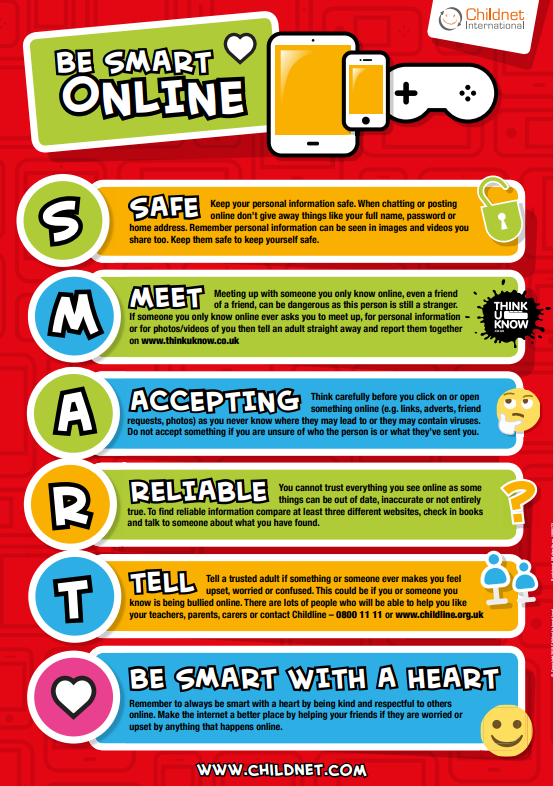
E-Safety is an important part of keeping children safe at Weeting CE Primary School . We have extensive security measures in place in school, which are monitored both internally and externally, to help safeguard pupils from potential dangers or unsuitable material. Any e-Safety incidents are recorded and managed. E-Safety is taught to all pupils explaining and demonstrating how to stay safe and behave appropriately online.
We can only be successful in keeping children safe online if we work with parents to ensure the E-Safety message is consistent. It is important that parents speak to their children about how they can keep safe and behave appropriately online.
Please follow the link below for further advice and guidance on how to keep our children safe online.
https://www.nspcc.org.uk/keeping-children-safe/online-safety/
It’s essential to be realistic - banning the Internet or technology will not work and it often makes a child less likely to report a problem. Education around safe use is essential.
Search engines
Please note that no search engine is ever 100% safe but below provides some links to some “safer” search engines:
Research searching
Image searching
Gaming
When children are accessing games via Xbox LIVE, privacy settings can be set up.